
ST. PAUL, Minnesota - 3M has agreed to commit $7.35 billion over nine years to resolve most current personal-injury claims involving PFAS chemicals in firefighting foam, one of the largest settlements yet tied to the persistent compounds known as forever chemicals.
The agreement addresses about 99% of current personal-injury claims inside and outside the federal multidistrict litigation over aqueous film-forming foam, or AFFF, 3M said Tuesday. Approximately 115,000 to 120,000 plaintiffs are eligible to participate.
The nominal commitment has a present value of $5.8 billion. 3M will record that amount as a pre-tax charge in the fourth quarter of 2026, although the company said it would exclude the charge as a special item from its adjusted results and leave its existing annual guidance unchanged.
Payments are scheduled over nine years, beginning with $50 million in 2026 and no payment in 2027. About 20% of the total is due in the final two years, a structure 3M said was designed to align with obligations from other legacy settlements.
The agreement is not an admission of liability. It remains subject to participation requirements and court procedures, and 3M said it was prepared to defend unresolved cases if agreed conditions are not satisfied.
A $680 million reserve within the overall commitment is intended to handle certain remaining and future claims. The federal court overseeing the AFFF litigation is also expected to establish evidence and timing requirements for people who seek to pursue cases later.
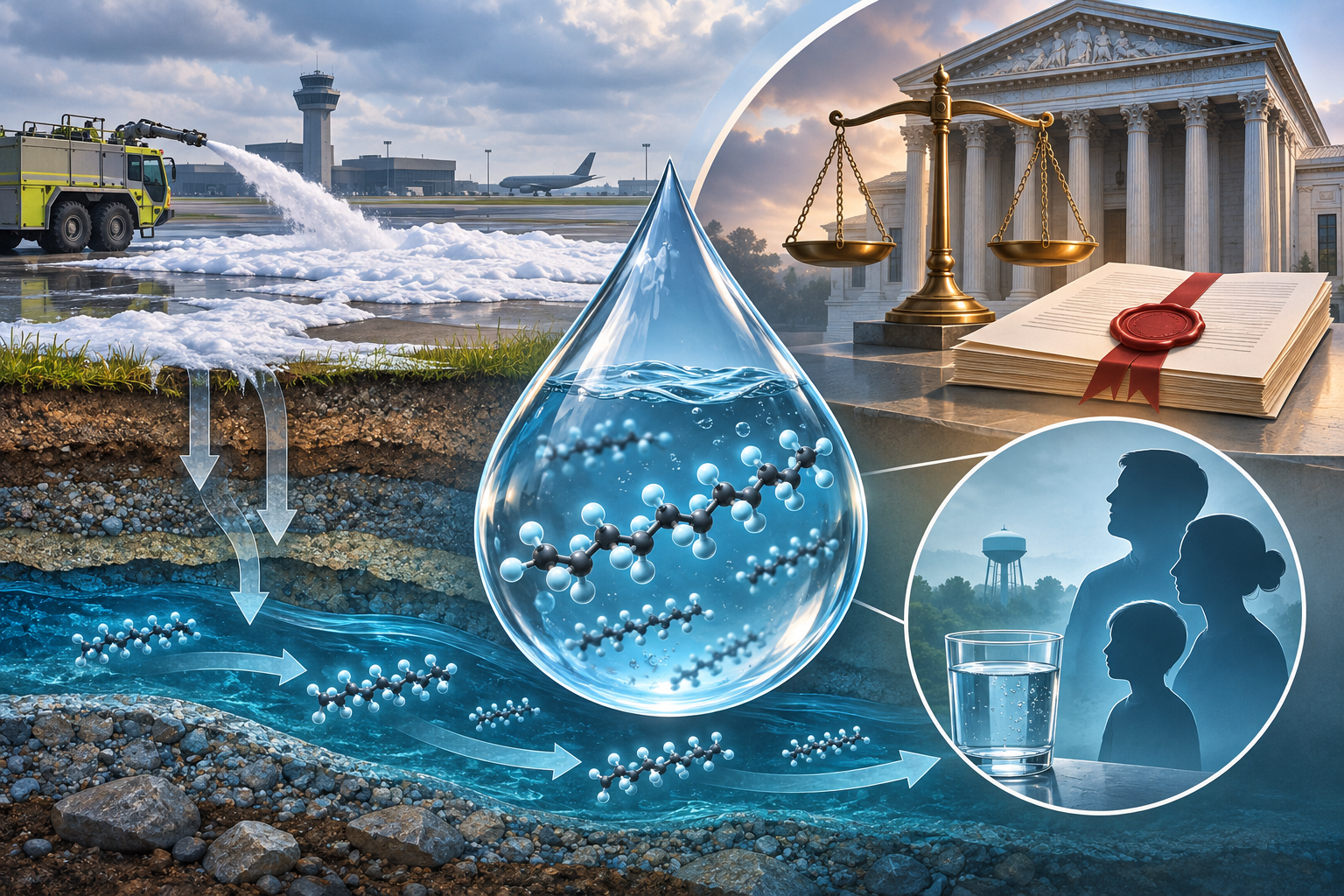
The claims largely involve exposure to PFAS compounds used in foam designed to extinguish fuel fires at airports, military bases, refineries, training facilities and other industrial sites. The foam can enter soil and groundwater when released during emergencies or repeated training exercises.
PFAS is a broad family of thousands of manufactured chemicals valued for resistance to heat, oil, water and stains. Many break down extremely slowly and can accumulate in people, animals and the environment, according to the U.S. Environmental Protection Agency.
Scientific studies have associated exposure to certain PFAS at some levels with increased risks of kidney, testicular and prostate cancers, reduced immune response, developmental effects and changes in cholesterol. The EPA cautions that the compounds vary and that research is continuing on how particular exposure levels relate to individual health outcomes.
That distinction matters in litigation. A population-level association does not prove that PFAS caused every illness alleged by an individual plaintiff. The settlement creates a mechanism for resolving claims without requiring each person and 3M to take causation disputes through separate trials.
3M said the legacy claims primarily concern compounds it began phasing out in 2000. The company also said it completed its plan to end all PFAS manufacturing worldwide by the end of 2025 and has invested in treatment and remediation at former production sites.
The new agreement follows a separate 2023 settlement under which 3M agreed to pay as much as $12.5 billion to public water systems over PFAS contamination. Other manufacturers, including Chemours, DuPont and Corteva, also face substantial PFAS litigation.
A settlement transfers cost but cannot remove contamination
The scale of this agreement reflects a failure that developed over decades. Chemicals were sold for useful properties, released through routine industrial and firefighting activity, and allowed to spread farther than the systems responsible for tracking their long-term consequences.
Compensation matters for people who say they became ill after exposure. So does legal finality for a company facing an immense group of claims. But neither the headline figure nor 3M's denial of liability answers every scientific question, and settlement is not the same as a public finding that each allegation was proved.
The deeper accountability test is whether the cost of preventing and cleaning contamination remains with the companies and institutions that benefited from the products rather than being shifted to taxpayers and local water customers.
Ending production is only one step because persistence is the defining problem. PFAS already present in aquifers, soil and human bodies will not disappear when a factory stops making more. Monitoring, treatment and medical research will continue long after the last settlement payment.
Regulators should require transparent reporting of chemical use, enforce drinking-water limits supported by current science and make manufacturers demonstrate safety before replacement compounds reach mass use. Substituting one poorly understood persistent chemical for another would repeat the same cycle.
Courts also need settlement systems that are understandable to claimants. With more than 100,000 potentially eligible people, payment criteria, medical documentation, legal fees and appeal rights must be clear enough that sick individuals are not lost inside an administrative process built for scale.
American industry depends on innovation, but a market cannot work honestly when profits are private and long-term contamination is treated as a public expense. The 3M agreement assigns a large price to past exposure. Real progress will be measured by whether future chemicals face serious scrutiny before another generation must litigate the consequences.
Comments
Loading comments…