
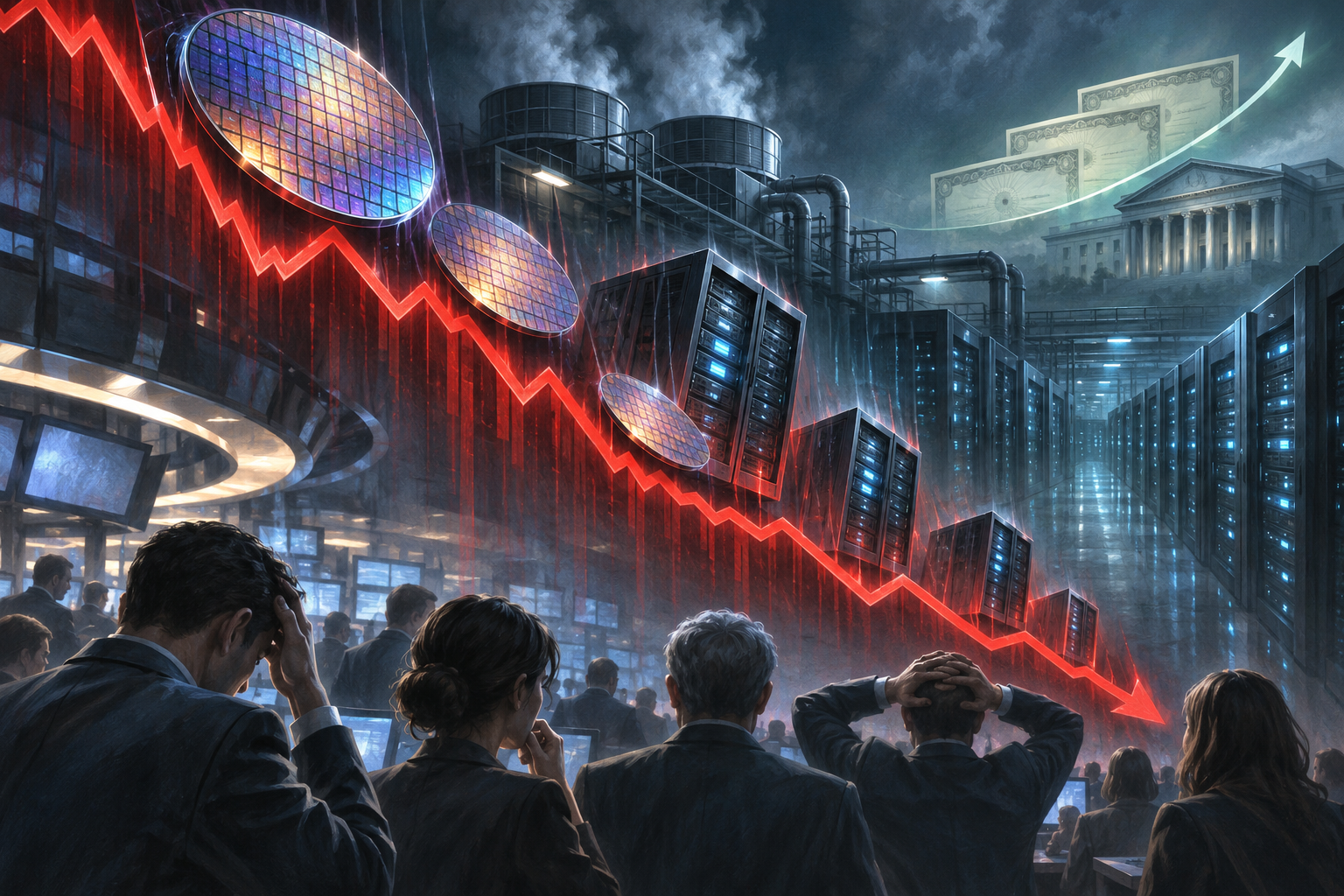
NEW YORK - A sell-off centered on artificial-intelligence and data-center companies erased about $2 trillion from the Nasdaq's market value on Thursday, driving the technology-heavy index into correction territory and producing Wall Street's worst session since the tariff shock of April 2025.
The S&P 500 fell 4.4%, its steepest one-day decline in roughly 19 months. The Dow Jones Industrial Average lost 1,833 points, or 3.4%, while the Nasdaq composite dropped 5.5% and closed 11.9% below the record it set last month. A decline of at least 10% from a recent peak is commonly described as a correction.
Every sector in the S&P 500 finished lower, but companies tied to AI infrastructure absorbed the heaviest losses. The Philadelphia Semiconductor Index fell about 12%, its second-biggest decline on record. Nvidia dropped 9.3%, Advanced Micro Devices lost 17.3%, and Micron Technology and Marvell Technology also fell about 17%, according to market reporting.
The damage extended beyond chipmakers. CoreWeave, which rents access to AI computing systems, fell 9.8%. GE Vernova, a major supplier to the power-hungry data-center industry, lost 7.5%. South Korea's Kospi index declined 5.3%, and Japan's Nikkei dropped sharply as the retreat spread through global markets.
Investors were reassessing the enormous construction program behind generative AI. Data centers require expensive chips, electricity, cooling systems, land and long-term financing. Higher borrowing costs had already raised questions about whether every planned project could deliver adequate returns.
Political risk intensified after Democrats won both chambers of Congress and captured governorships in states central to the data-center boom. Incoming leaders in Texas and Ohio campaigned for pauses or stronger conditions on new developments, including requirements that operators cover utility costs and provide benefits to local communities.
That does not mean the election alone caused the market decline. AI stocks entered the week with elevated valuations after several years of extraordinary gains, and investors had been debating whether spending was running ahead of revenue. The election supplied a new reason to reduce risk in a trade already vulnerable to disappointment.
Money moved toward safer assets as stocks fell. The yield on the 10-year Treasury note declined to 4.84% from 4.90% a day earlier, suggesting stronger demand for government bonds. Brent crude rebounded 3.9% to $98.29 a barrel, adding uncertainty for companies and households already facing higher energy costs.
AI remains powerful, but the investment case is no longer automatic
The sell-off does not prove that artificial intelligence is a failed technology. Companies are deploying models in software development, medicine, logistics, finance and national security. Demand for computing remains substantial, and a single day of trading cannot determine the industry's long-term value.
What changed is the market's willingness to treat every layer of the AI buildout as equally valuable. Chipmakers, cloud providers, utilities, construction firms and speculative data-center operators had risen together because investors assumed infrastructure demand would expand almost without limit.
That assumption ignored a basic distinction: useful technology does not guarantee attractive returns at every price. A data center can be technically impressive and still be a poor investment if electricity costs rise, financing becomes expensive, local permits are delayed or customers refuse to pay enough for the computing it provides.
The political backlash is also understandable. Communities have watched large projects request power connections, tax incentives and water while households worry about utility bills. AI companies have often described their expansion as nationally essential but expected local residents to accept the immediate costs. Voters are now asking for a clearer bargain.
America should continue building advanced computing capacity. Surrendering leadership would strengthen authoritarian rivals that treat AI as an instrument of state power as well as economic competition. But national strength is not served by poorly financed projects, hidden subsidies or the belief that market discipline should be suspended for any company using the term AI.
Thursday's rout may create its own risks. Large technology companies now carry enormous weight in major indexes, so their decline can damage retirement accounts and confidence far beyond specialist investors. When one investment theme becomes a central engine of economic growth, a correction in that theme can quickly become a broader shock.
The healthier outcome would be selection rather than retreat: capital flowing to companies with real customers, reliable power plans and defensible economics while weaker projects lose funding. That process is painful because markets spent years rewarding ambition before demanding proof.
The AI era is not ending. The period in which spending announcements automatically lifted share prices may be. Investors have started asking who will earn enough to justify the cost, and the industry now has to answer.
Comments
Loading comments…