
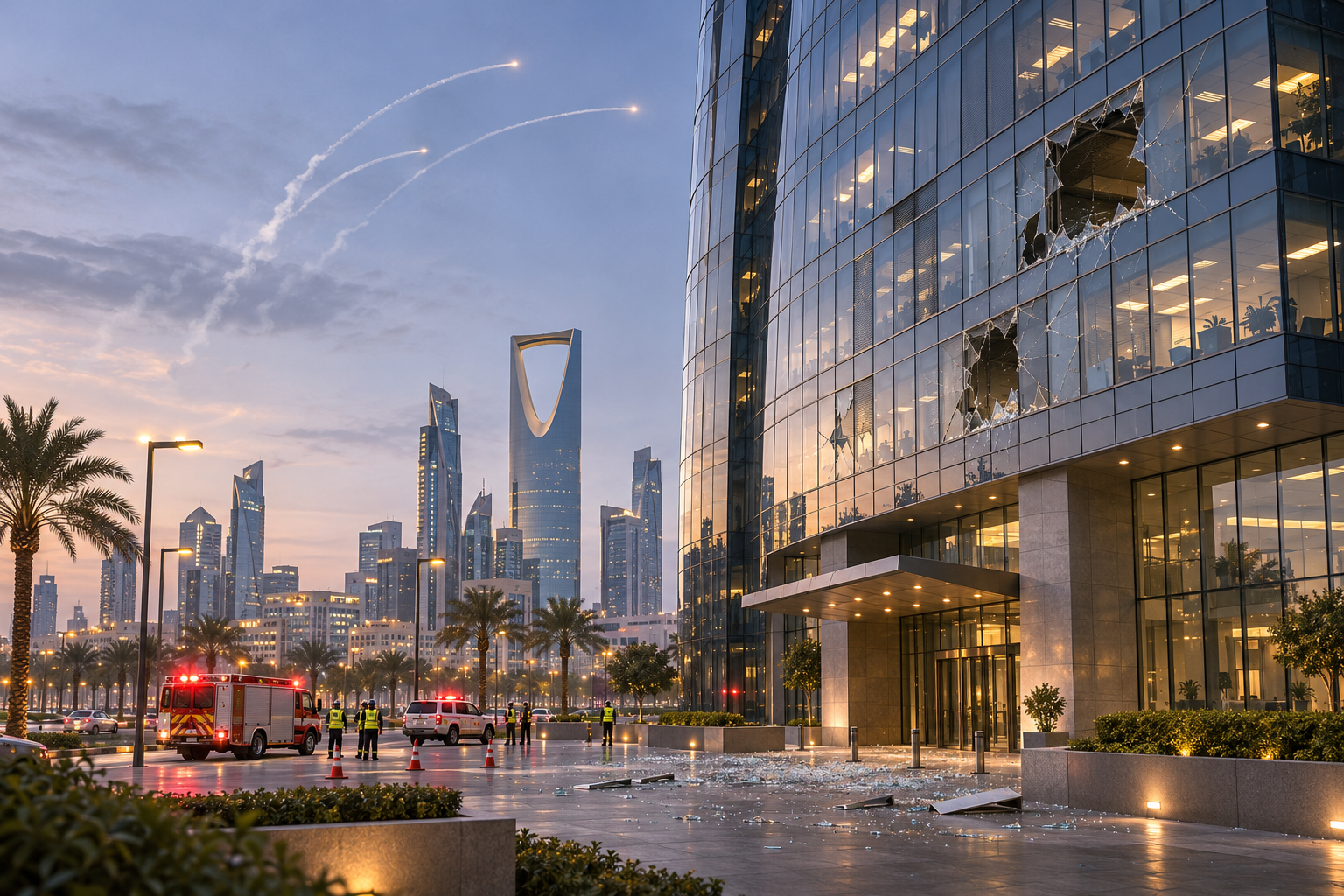
RIYADH - Falling debris damaged a Saudi Aramco administrative tower in central Riyadh on Sunday after air defenses intercepted missiles during a new Houthi barrage against Saudi Arabia, authorities and news agencies reported.
Windows were blown out across several floors of the office in the King Abdullah Financial District, one of the capital's most prominent business areas. Saudi Arabia's Energy Ministry said the attempted attack caused limited damage and reported no injuries or deaths.
The Saudi-led coalition fighting Yemen's Iran-aligned Houthi movement said it intercepted two ballistic missiles fired toward Riyadh. The Associated Press reported that Saudi defenses intercepted two ballistic missiles and two cruise missiles aimed at the capital and other regions during the wider assault.
The Energy Ministry did not publicly identify who was responsible for the debris that struck the building. The coalition blamed the Houthis for the incoming weapons, while Houthi military spokesman Yahya Saree claimed a broader series of attacks against Saudi targets, including Aramco facilities.
Air defenses also intercepted weapons aimed at Saudi Arabia's Eastern and southern regions, according to official and media reports. The Eastern Province contains most of the kingdom's oil and gas reserves, making any attack there a potential threat to both Saudi revenue and global energy markets.
There was no immediate report of damage to oil production from the Riyadh incident. The affected building was a corporate office, not a refinery, pipeline or export terminal. That distinction matters because images of shattered glass at an Aramco property can move faster than confirmed information about whether crude supplies are affected.
The Houthis have increased missile and drone attacks on Saudi airports, ports and energy sites since fighting resumed in July. The escalation has opened another front in the broader Middle East conflict that intensified after U.S. and Israeli attacks on Iran in February.
Saudi Arabia and the Houthis also traded accusations over deadly violence in Yemen. The Houthi-run Health Ministry said Saudi airstrikes near Sanaa on Saturday killed at least 33 people and wounded dozens. The casualty figures and responsibility could not be independently verified immediately, but the claims underline how quickly retaliation can deepen the cycle.
Sunday's interceptions showed that Saudi defenses can stop incoming weapons before they reach their intended targets. They also demonstrated that a successful interception is not the same as a harmless event. Fragments still fall over homes, roads and offices, and the population below carries the risk.
Missile defense buys protection, not a permanent solution
The attack appears to have failed in its immediate objective. No one was killed, the damage was limited and there was no reported production outage. That is a success for Saudi air defenses and for the personnel who kept an urban strike from becoming a mass-casualty event.
Yet the shattered tower exposes an uncomfortable limit. Defensive systems can reduce the damage caused by ballistic and cruise missiles, but they cannot guarantee that a capital remains untouched. Attackers need only send another barrage; defenders must detect, track and defeat every weapon while managing the debris.
Aramco is an obvious symbolic target because it sits at the center of Saudi power and the global oil system. Striking even an administrative office creates dramatic images and uncertainty. The military value may be small, but the psychological and financial effects can be much larger.
The Houthis have become capable of imposing costs far beyond Yemen despite years of war and pressure. Their relationship with Iran gives Riyadh and Washington reason to treat the threat as part of a regional network. But attribution for a specific attack still must rest on evidence, not assumption, and Iranian alignment does not by itself prove direct command from Tehran.
Saudi Arabia has legitimate grounds to defend its cities and infrastructure. It also has a responsibility to avoid turning that defense into an open-ended campaign in which Yemeni civilians pay for every Houthi launch. Retaliation that kills families can strengthen the movement's recruitment and provide propaganda for the next attack.
American security support remains important, particularly for integrated radar, interception and intelligence. Washington should help allies protect civilian areas while pressing for clear rules, independent casualty reporting and a path back to negotiations. Deterrence without diplomacy can become an expensive machine that only prepares for the next exchange.
The deeper danger is normalization. A missile alert over Riyadh, broken glass in a financial district and airstrikes near Sanaa should not become routine background noise. Each round makes a larger error more likely, and the next piece of debris may not land in an empty office.
Sunday's outcome was fortunate. The defenses worked well enough to prevent deaths, but the attack still reached the physical and political heart of the kingdom. That is a warning that military protection can create time for diplomacy; it cannot substitute for it.
Comments
Loading comments…