
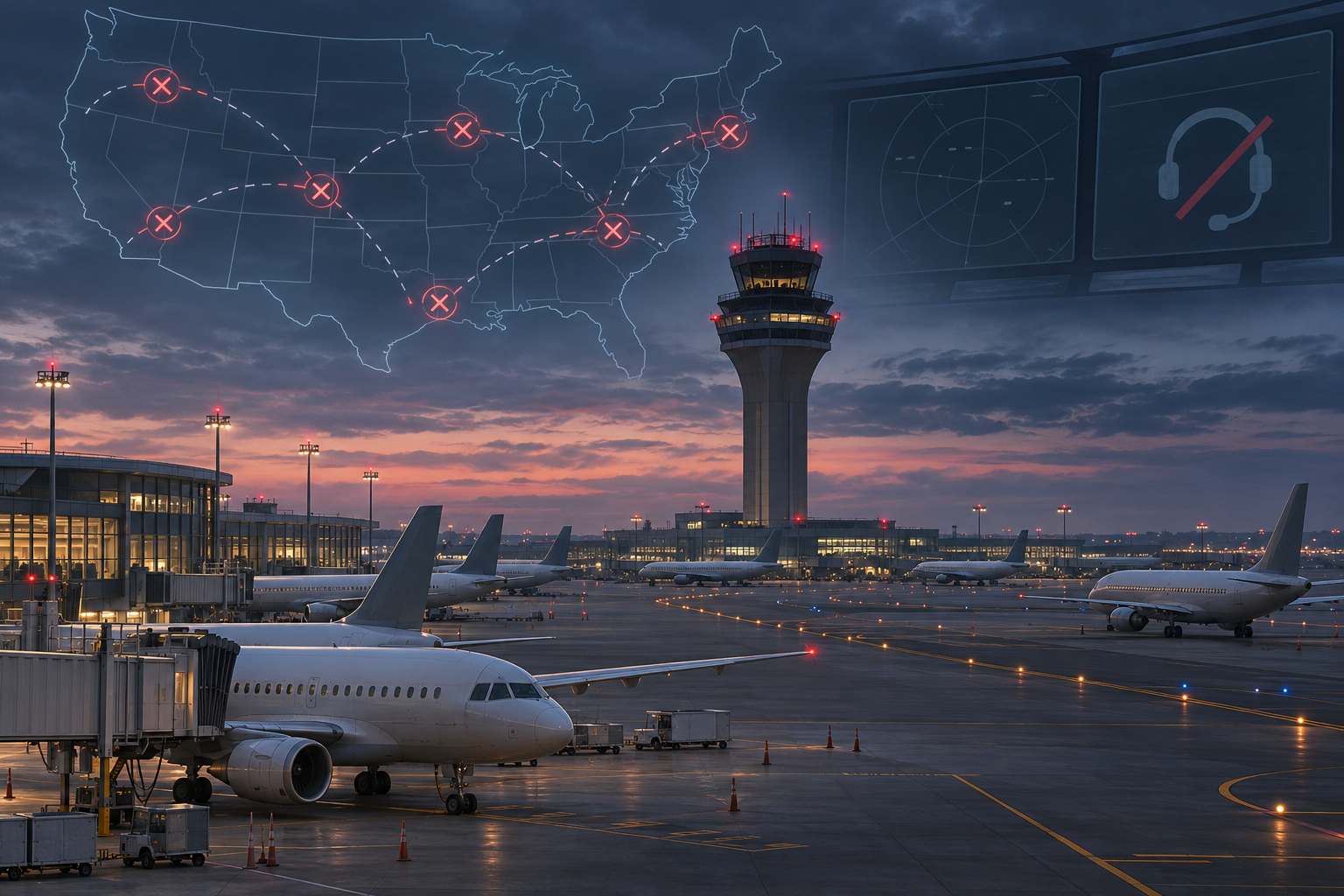
WASHINGTON - The Federal Aviation Administration grounded all departing flights across the United States on Friday after a communications failure affected the regional centers that direct aircraft between airports.
The nationwide order was issued at 3:54 p.m. Eastern time under what the FAA called extraordinary circumstances and for reasons of safety. Transportation Secretary Sean Duffy said the problem affected the 22 Air Route Traffic Control Centers responsible for managing high-altitude traffic across the country.
Aircraft already in the air were allowed to continue to their destinations or divert safely. Flight-tracking service Flightradar24 counted 4,042 aircraft bound for U.S. airports when the stop began. Inbound international flights were handled individually while domestic departures remained on the ground.
The disruption rapidly spread through airline networks. Reuters reported that airlines had canceled more than 1,000 flights and delayed nearly 10,000 by early evening, citing FlightAware. Axios later reported more than 4,000 cancellations and 10,000 domestic delays over the course of Friday as of 7:15 p.m. Eastern.
Those figures were changing as carriers adjusted schedules, crews and gates. Airports from Boston and New York to Chicago, Seattle and Los Angeles filled with stranded passengers, while arriving aircraft waited for parking positions already occupied by planes unable to depart.
Homeland Security Secretary Markwayne Mullin said there was no indication that the outage was a cyberattack or another malicious act. He described it as a telecommunications outage while stressing that investigators were examining all possible causes. Officials had not publicly established a final cause by late Friday.
The FAA said technicians were investigating. Airline officials told Reuters that the agency had not provided a firm time for lifting the order, although there were preliminary signs that communications were improving in some locations.
It was only the second nationwide FAA ground stop since the September 11, 2001, attacks. The previous one came in January 2023, when the failure of a pilot-alert system halted domestic departures for less than two hours.
Friday's failure renewed attention on an air traffic system that still depends on decades-old equipment. Congress approved $12.5 billion last year to begin a major modernization program. The White House and Transportation Department have asked lawmakers for an additional $30.1 billion to complete wider upgrades.
The outage followed repeated regional communications failures and came as the FAA was introducing new technology across the national airspace system. Officials said they would examine whether any new system was connected to Friday's breakdown, but no link had been established.
The ground stop was the right decision, but the failure demands answers
Stopping departures across the world's busiest airspace is an extraordinary measure. It was also the responsible one. When controllers cannot rely on the communications needed to separate aircraft across large regions, keeping planes on the ground protects passengers and gives the system room to recover.
The safe handling of thousands of aircraft already airborne shows the professionalism built into American aviation. But safety on Friday depended on accepting enormous disruption because a national communications layer could not be trusted. That is a warning about resilience, not a reason for panic.
Modern air traffic control cannot be treated like an ordinary office network. A single failure can strand passengers, displace crews, block gates and create effects that last long after technicians restore service. Redundant paths, independent backup systems and rigorous testing must be designed for simultaneous national stress.
Washington should resist two easy reactions. The first is speculation that every unexplained outage is an attack. Officials said they had no evidence of malicious action, and inventing one would distract from the technical investigation. The second is accepting aging infrastructure as an unavoidable inconvenience.
Congress should demand a public timeline of what failed, which backup systems worked and why a problem reached all 22 centers. Sensitive security details can remain protected, but travelers and controllers deserve more than a general promise that modernization is underway.
Money must be tied to measurable milestones: obsolete circuits retired, communications paths diversified, controller workstations upgraded and recovery exercises completed under independent observation. Contractors should be judged on operational reliability rather than slide presentations or launch dates.
America's aviation system remains one of the country's great public achievements. Its strength comes from acknowledging failures, investigating them openly and correcting them before the next emergency. Friday's safe ground stop prevented a communications problem from becoming a safety crisis. The harder task is ensuring the same nationwide shutdown is never needed for the same reason again.
Comments
Loading comments…