
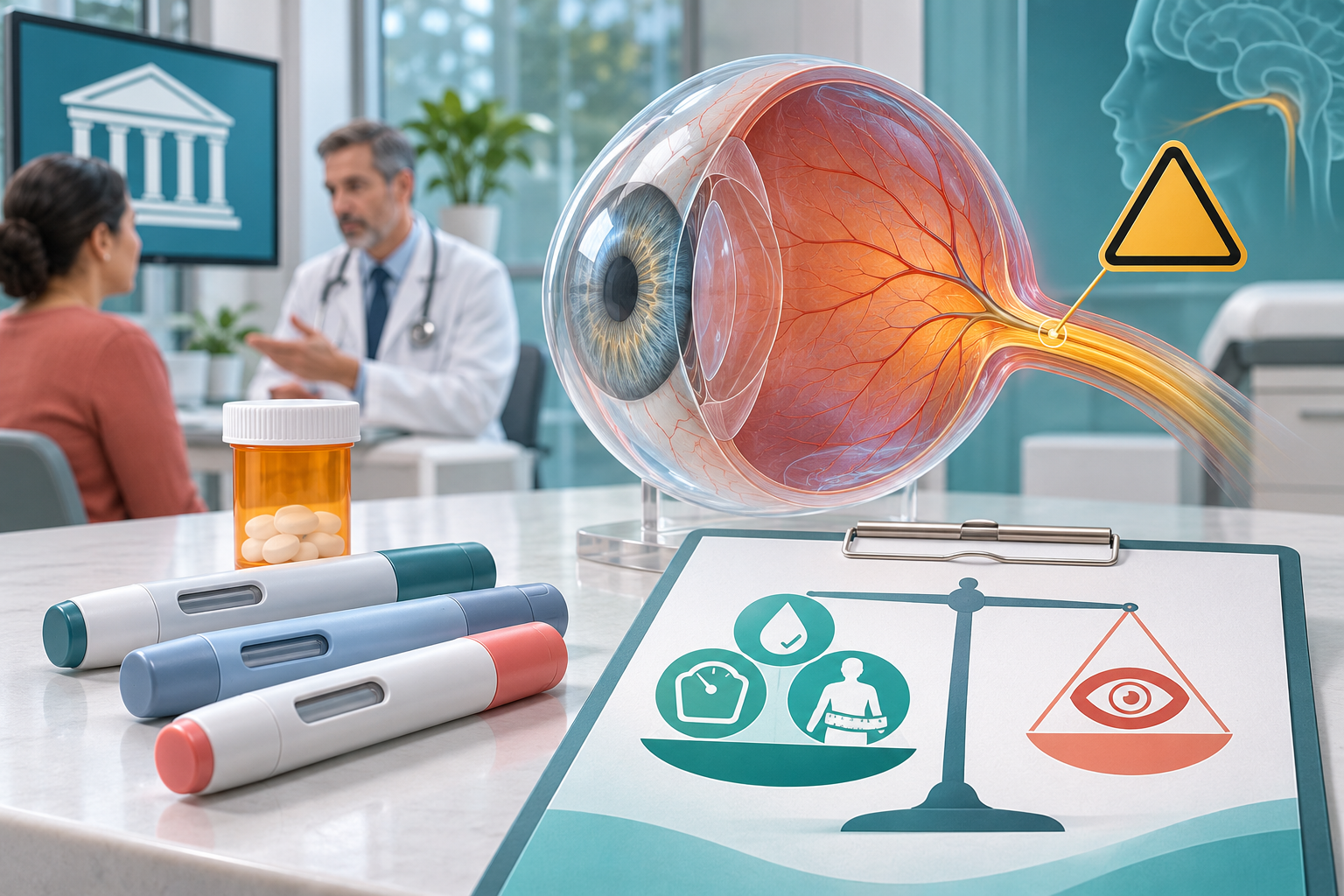
WASHINGTON - The Food and Drug Administration is requiring new warning labels for all GLP-1 diabetes and weight-loss medicines after concluding that patients may face an increased risk of a rare optic-nerve condition that can cause sudden and sometimes permanent vision loss.
The class-wide action covers widely used medicines including Novo Nordisk's Ozempic and Wegovy and Eli Lilly's Mounjaro and Zepbound, as well as other injectable and oral products with GLP-1 receptor agonist activity.
The condition is non-arteritic anterior ischemic optic neuropathy, known as NAION. It occurs when blood flow to the optic nerve is disrupted and typically causes acute, painless loss of vision in one eye. Damage can be permanent.
The FDA said information about the potential risk must be added to the warnings and precautions section of prescribing labels. The agency advised patients to report sudden or painless vision loss, missing areas in their field of view or other new visual disturbances promptly to a health professional.
The risk signal remains small in absolute terms. An FDA analysis of 126 randomized controlled trials found 6.4 NAION cases per 100,000 person-years among patients receiving GLP-1 medicines, compared with 3.8 cases per 100,000 person-years among patients receiving placebo or another glucose-lowering treatment.
Those figures indicate an association that regulators consider important enough to disclose, but they do not mean most patients are in danger or establish that the drugs directly caused every reported case. NAION also occurs in people with diabetes, obesity, high blood pressure and other cardiovascular risk factors that are common among patients prescribed these medicines.
FDA scientists began examining the issue after a 2024 study reported a possible link between semaglutide and NAION in a group of ophthalmology patients. The agency subsequently reviewed clinical trials, observational evidence and reports collected after medicines reached the market.
Novo Nordisk said available evidence does not establish a cause-and-effect relationship and maintained that the benefits of its GLP-1 medicines continue to outweigh their risks. Eli Lilly noted that the FDA communication applies to the full drug class and did not identify a finding specific to Lilly products.
GLP-1 medicines have transformed treatment for type 2 diabetes and obesity. They can produce substantial weight loss, improve blood-sugar control and reduce cardiovascular risk for some patients. Demand has expanded rapidly as new formulations and indications reach the market.
The FDA did not advise patients to stop treatment on their own. Abruptly abandoning a medicine can allow blood sugar or weight-related risks to worsen, and individual decisions should be made with a clinician who understands the patient's health history and symptoms.
A rare risk still matters when millions use the medicine
Safety warnings are sometimes treated as proof that a drug is dangerous or that regulators failed. That is the wrong lesson. Medicine is a balance of benefit and harm, and labels are supposed to change when better evidence reveals a risk that doctors and patients should discuss.
The absolute numbers here are reassuringly low. The trial analysis suggests only a few additional cases for every 100,000 person-years of treatment. For a patient whose diabetes, cardiovascular disease or severe obesity creates a much larger threat, the benefit may remain decisive.
Scale changes the public-health calculation. When millions of people take a medicine, even a very rare complication can affect a meaningful number of families. Patients deserve clear information before symptoms appear, especially because rapid evaluation of sudden vision changes may help rule out other emergencies.
Drugmakers also have an obligation to avoid minimizing uncertainty. Saying that causation has not been proven is scientifically correct, but it should not become a marketing shield. Companies hold enormous amounts of clinical and post-market data and should make analyses available for independent review.
Regulators must be equally disciplined. Warnings should describe the size of the risk, the quality of the evidence and the action patients should take. A frightening label without context can cause people to abandon effective treatment, while a vague label can be ignored.
America's system works best when adverse events are reported, studied openly and translated into practical guidance. That process is slower than advertising and less dramatic than social-media claims, but it is how confidence is earned.
The new warning is not a reason for panic and it is not permission to dismiss the concern. Patients should know the symptoms, clinicians should consider individual eye and vascular risk, and manufacturers should continue rigorous surveillance as use grows.
GLP-1 medicines remain powerful tools, not miracles without tradeoffs. The FDA's action makes that reality more visible and gives patients a better basis for deciding, with medical advice, whether the benefit is worth the rare risk.
Comments
Loading comments…