
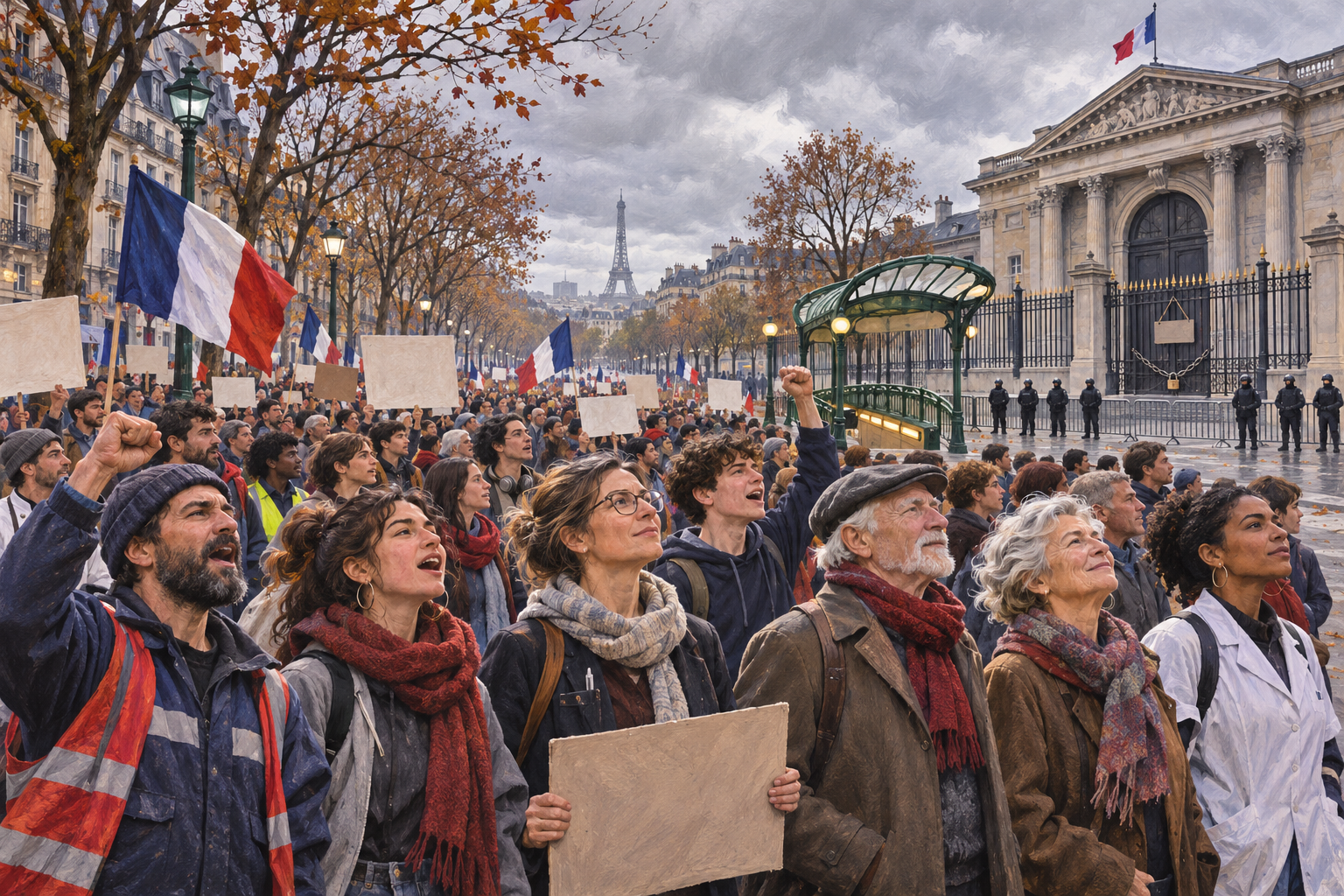
PARIS - More than 600,000 people marched across France on Thursday to demand higher wages, stronger public services and better conditions for students, according to the Interior Ministry, in the largest turnout of a protest movement that has challenged President Emmanuel Macron's government for weeks.
The CGT trade union put participation much higher, at nearly 1.6 million people in more than 200 demonstrations. Crowd estimates commonly differ between French authorities and organizers, but both figures showed a broad national mobilization involving workers, students and retirees.
The main Paris march was largely peaceful. Demonstrations also took place in Lyon, Marseille, Nantes, Rennes, Toulouse and many smaller cities. The Eiffel Tower closed for the day, public transportation was disrupted in some areas and a strike by power workers reduced French nuclear output by about 2.4 gigawatts early Thursday.
Education was a central part of the action. About one-third of France's high schools were closed or unable to operate because of student blockades and teacher walkouts. The Education Ministry said more than 15% of teaching staff joined the strike, while unions representing rail workers, hospital employees and postal workers also called members into the streets.
Organizers are demanding an increase in the minimum wage, broader pay raises, tax changes and better learning conditions. Unions said the cost of fuel, food, rent, gas and electricity had climbed while wages and pensions failed to keep pace. Students focused on overcrowding, staff shortages and uncertainty about employment after graduation.
Authorities deployed 70,000 police officers nationwide, supported by armored vehicles, drones and helicopters. The heavy security presence followed serious rioting and looting during earlier demonstrations in October.
Thursday's marches avoided a repeat of that scale of destruction, although tensions flared in several cities. Police used tear gas in Paris, officials reported clashes or attempted road blockades in Rennes and other cities, and the Interior Ministry said at least 448 people were arrested. Authorities accused masked groups of trying to exploit the protests for violence.
The movement began in September with a dispute over staffing at a high school southeast of Paris. It expanded into a student campaign for education funding and then into a broader challenge over wages, pensions, public services and the cost of living. The timing places the unrest directly in France's political debate five months before a presidential election.
A democratic warning the government cannot police away
France has a long tradition of strikes, but the composition of these crowds matters. This is not only a union campaign or a student revolt. Teachers, health workers, transport employees, pensioners and young people are expressing different versions of the same concern: the economy may be functioning on paper while ordinary life becomes harder to afford.
A democratic government has a duty to protect peaceful assembly and to stop rioters from attacking people or property. Those obligations are compatible. Treating every march as a security threat would punish lawful citizens for the actions of violent groups; ignoring arson, looting or attacks on police would allow those groups to destroy public support for the movement.
The deployment of 70,000 officers may have helped prevent a repeat of October's disorder. It is not an economic policy. Police can keep a route open and arrest people who commit crimes, but they cannot raise real wages, repair a school or convince a hospital worker that chronic shortages are temporary.
Macron's government faces a genuine constraint. France carries heavy public debt, and the 2027 budget debate includes plans for roughly 45 billion euros in cuts. Granting every demand without sustainable funding would push costs onto future taxpayers and could worsen the instability protesters fear.
That fiscal reality does not erase political responsibility. Governments lose trust when they present austerity as unavoidable while citizens believe influential companies and wealthy households receive better access and protection. A credible response must show which sacrifices are necessary, who will bear them and what measurable improvement the public will receive.
The size of Thursday's mobilization also exposes a wider European problem. High living costs, housing pressure and weak confidence in public institutions have fueled unrest in several countries. When mainstream leaders leave those grievances unanswered, populists and extremists gain an opportunity to claim that democratic politics itself is incapable of delivering.
France should resist both temptations: the radical claim that violence is the only language government understands and the official claim that order alone will end the crisis. The peaceful majority in the streets is using a democratic right to demand an answer. The government's harder task is to provide one that is honest about limits without treating public anger as illegitimate.
Thursday's turnout is not a mandate for every union proposal, but it is a warning that economic confidence has broken across generations. France can contain a march for a day. It must now address the conditions that keep bringing people back.
Comments
Loading comments…