
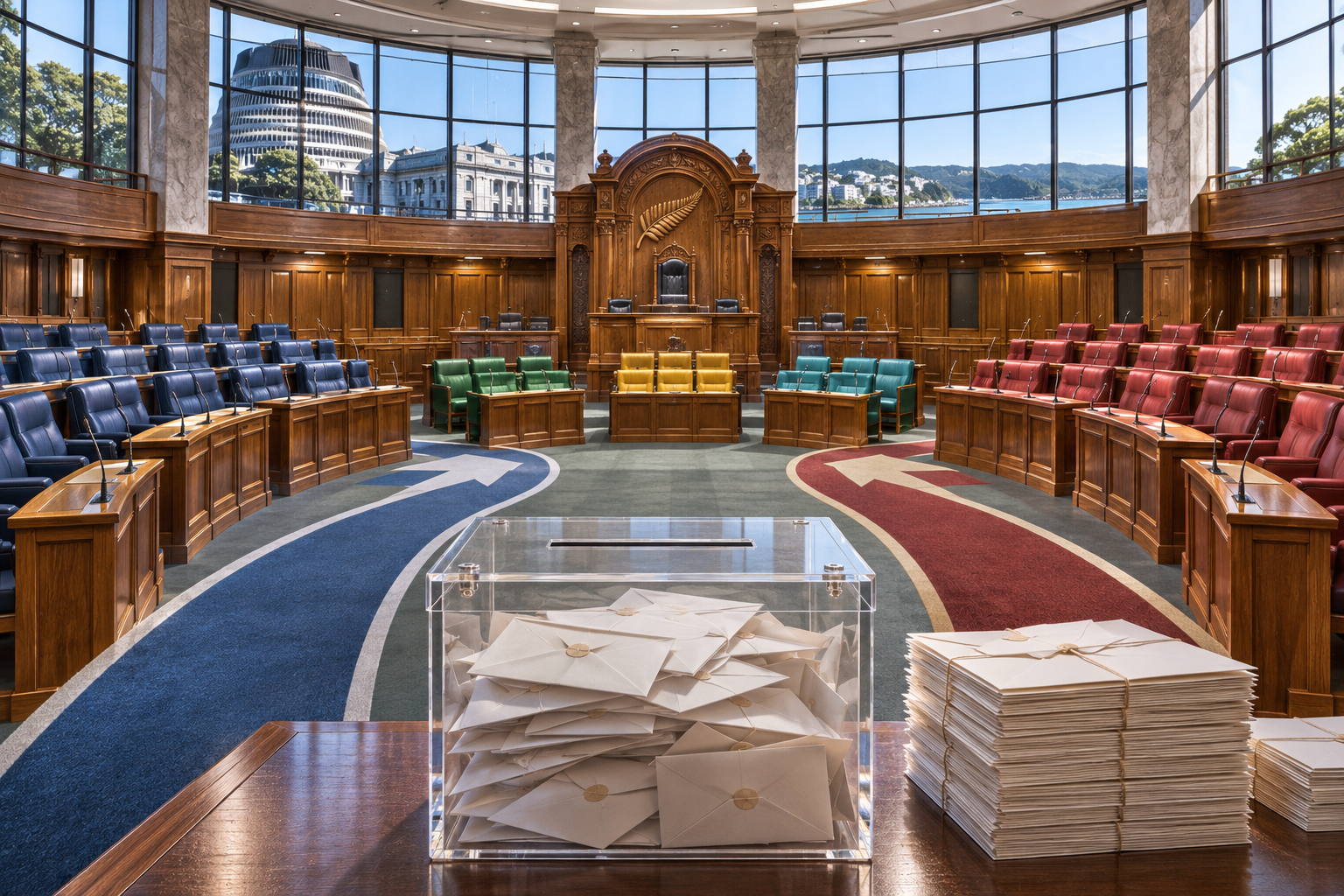
WELLINGTON - New Zealand's general election ended without a clear winner on Saturday, leaving Prime Minister Christopher Luxon's conservative coalition with a one-seat preliminary majority and almost 400,000 special ballots still to be counted.
The Electoral Commission's completed preliminary count projected a 131-seat parliament. Luxon's National Party won 42 seats, while its current coalition partners ACT New Zealand and New Zealand First secured 13 and 12 respectively. Together they held 67 seats, one more than the 66 required for a majority.
Labour narrowly led the nationwide party vote, receiving 29.36% against National's 29.21%, a difference of 3,650 votes. Yet National won more electorate seats and emerged with six more seats in parliament than Labour, which was projected to hold 36.
The Green Party won 16 seats, the Opportunity Party entered parliament with seven, and Te Pati Maori secured five electorate seats. New Zealand's mixed-member proportional system combines a nationwide party vote with local electorate contests, and the interaction between those results expanded the projected chamber beyond its usual 120 members.
Neither Luxon nor Labour leader Chris Hipkins claimed victory. Luxon told supporters the race was too close to call, while Hipkins refused to concede and said every ballot needed to be counted. The cautious speeches reflected how easily the final seat distribution could change.
The commission estimated that 399,365 special votes remained, including 96,947 overseas and dictation ballots. Those votes represent roughly 14% of the expected total. Officials will also recount ordinary ballots, check electoral rolls and transport special votes to their home electorates before releasing the official result on November 27.
Special votes have shifted seats toward parties on the left in recent New Zealand elections. In the past four contests, National lost one or two seats after the final count, according to election reporting. A similar movement this year could erase the governing bloc's single-seat advantage and force a different coalition arrangement.
The preliminary results also showed declining dominance by the two traditional major parties. National and Labour each received less than 30% of the party vote, their weakest combined share since New Zealand introduced the MMP system. ACT, New Zealand First, the Greens and the Opportunity Party all gained leverage over the next government.
The campaign centered on living costs, a soft economy, housing and pressure on public services. Luxon sought a second term after three years leading a coalition with ACT and New Zealand First. Hipkins argued that the government had failed to improve affordability and asked voters to return Labour to power.
The uncertainty is democracy working, not democracy failing
A one-seat margin naturally creates anxiety, but New Zealand's response offers a useful democratic lesson. The leaders did not invent victory, attack election workers or demand that counting stop when the numbers became inconvenient. They acknowledged the uncertainty and told the country to wait for the lawful process.
That should be ordinary behavior. Around the world it increasingly is not. Authoritarian governments produce immediate results because genuine competition has already been removed. Democracies sometimes need weeks because overseas votes must travel, close races must be checked and every valid ballot carries equal weight.
The result also exposes the harder side of proportional politics. Voters may prefer broad representation, but a fragmented parliament gives smaller parties influence far beyond their raw size. National cannot govern securely without ACT and New Zealand First. Labour would need support from several parties with different priorities, and possibly a partner from the current governing bloc.
Coalition bargaining is legitimate, but it must be transparent. Agreements on taxes, public spending, indigenous policy and institutional reform should be published clearly rather than hidden behind private promises made to secure a few decisive votes.
New Zealand's next government will also face choices larger than domestic politics. The country depends economically on trade with China while relying on deep security relationships with Australia and other democracies. A weak coalition could be tempted to avoid difficult foreign-policy decisions, but strategic ambiguity does not remove pressure from Beijing or instability in the Indo-Pacific.
The opportunity is to demonstrate that democratic competition can produce both representation and governability. That requires the losing side to accept a verified result, the winning side to exercise restraint and minor parties to understand that leverage is not a license for permanent crisis.
The preliminary count is not a mandate for either bloc. It is an instruction to finish the count carefully. New Zealanders have delivered a divided verdict, and the legitimacy of the next government will depend less on who declares victory first than on whether every party respects the process that establishes it.
Comments
Loading comments…