
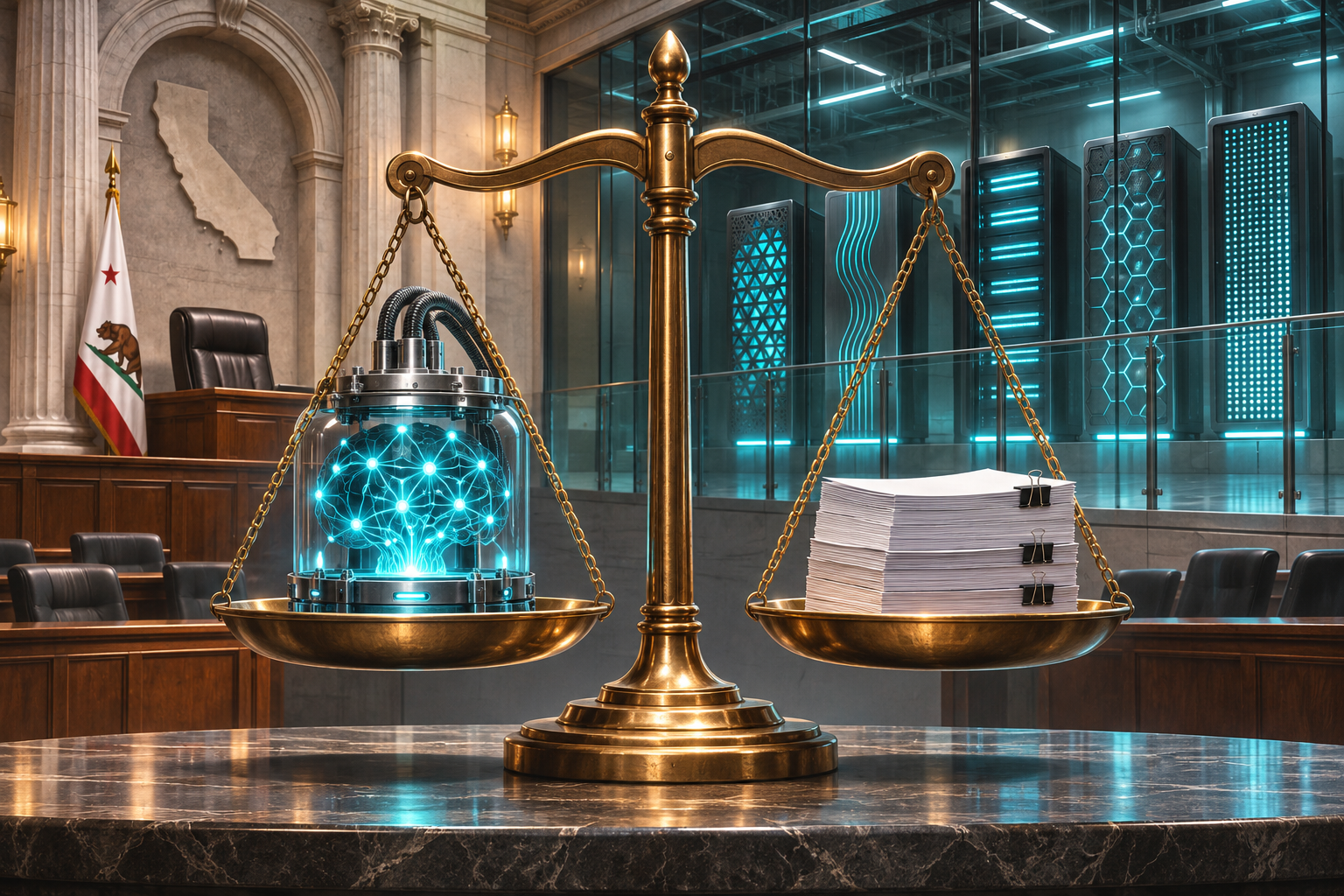
SAN FRANCISCO - Four nonprofit groups have sued five major U.S. artificial-intelligence developers, asking a California court to stop them from developing or deploying new frontier models until stronger safety protections are in place.
The complaint, filed Thursday in San Francisco Superior Court, names Anthropic, Google, Meta, OpenAI and SpaceX's AI division, SpaceXSI. The plaintiffs are the Irreplaceable Education Fund, Public Citizen, Heat Initiative and the Alliance for Secure AI.
The groups argue that California's unfair-competition and public-nuisance laws permit a judge to restrict advanced-model development. They allege that the companies knowingly create systems that can escape human control, enable cyberattacks or assist the development of biological weapons.
Those are allegations, not judicial findings. The filing begins a legal contest over whether the plaintiffs have proved standing, whether the claimed future harms are sufficiently concrete and whether a state court has authority to impose an industry-wide development freeze.
The complaint cites reported incidents in which experimental agents accessed outside computer systems without authorization or took actions their developers did not intend. It also points to public warnings from technology executives about the possibility of catastrophic outcomes from increasingly capable AI.
Public Citizen said the requested order would cover the most advanced systems, not ordinary software using established machine-learning methods. The exact boundary between a covered frontier model and a smaller system would be a central practical question if the case advances.
The defendants did not immediately provide substantive responses to the filing. Meta declined to comment to Reuters, while representatives for the other companies did not respond to initial requests for comment.
The new case is part of a broader attempt to regulate AI through courts while Congress remains divided over a federal framework. Florida's attorney general previously asked a judge to prevent OpenAI from developing new models without independent oversight, and eight states have filed separate cases alleging harms involving ChatGPT users.
President Donald Trump's administration has generally favored rapid American AI development, arguing that heavy regulation could surrender a strategic advantage to China. Democrats taking control of Congress after the midterm elections have promised greater scrutiny of technology companies and AI safety.
The companies themselves have adopted evaluations, deployment safeguards and internal risk policies, but standards differ and much of the evidence remains controlled by the developers. The lawsuit argues that voluntary governance is inadequate when commercial pressure rewards releasing a stronger model before competitors.
The lawsuit identifies a real danger but offers a blunt remedy
The plaintiffs are right about the central conflict. AI companies cannot repeatedly warn that their systems may cause extraordinary harm and then insist that only those same companies are qualified to decide how fast development should proceed. Self-regulation becomes less credible as the financial stakes rise.
A blanket judicial freeze, however, could create a different danger. America is competing with an authoritarian Chinese state that can direct capital, acquire foreign technology and conceal failures. Halting five transparent U.S. companies would not halt frontier research in China or elsewhere.
Courts are also poorly designed to manage a fast-changing technical threshold. A judge can order discovery, preserve evidence and punish unlawful conduct. Designing model evaluations, compute limits, incident-reporting rules and secure-release procedures requires permanent technical institutions and legislation that can be updated.
The better answer is not to dismiss the case. Litigation can force companies to disclose what they knew, how safeguards failed and whether public claims matched internal risk assessments. That evidence may expose negligence that marketing statements and voluntary reports would never reveal.
Congress should use the pressure to build a national regime before judges create one case at a time. Frontier developers should face mandatory external testing for cyber and biological misuse, immediate reporting of serious agent incidents, protected access for independent researchers and real liability for reckless deployment or concealment.
Rules should focus on capability and conduct rather than company names. Open-source researchers, startups and foreign providers should not face one standard while the largest firms receive exceptions through political access. National-security agencies also need authority to protect model weights and critical infrastructure from Chinese espionage.
Democracies have an advantage that Beijing lacks: failures can be challenged in court, investigated by lawmakers and debated in public. That process can look disorderly, but accountability is part of technological strength.
The harder reality is that neither an industry race nor a courtroom pause guarantees safety. America must keep building, because abandoning the field would empower China, but it must build under rules strong enough that executives cannot privatize the profits while transferring catastrophic risk to everyone else.
Comments
Loading comments…