
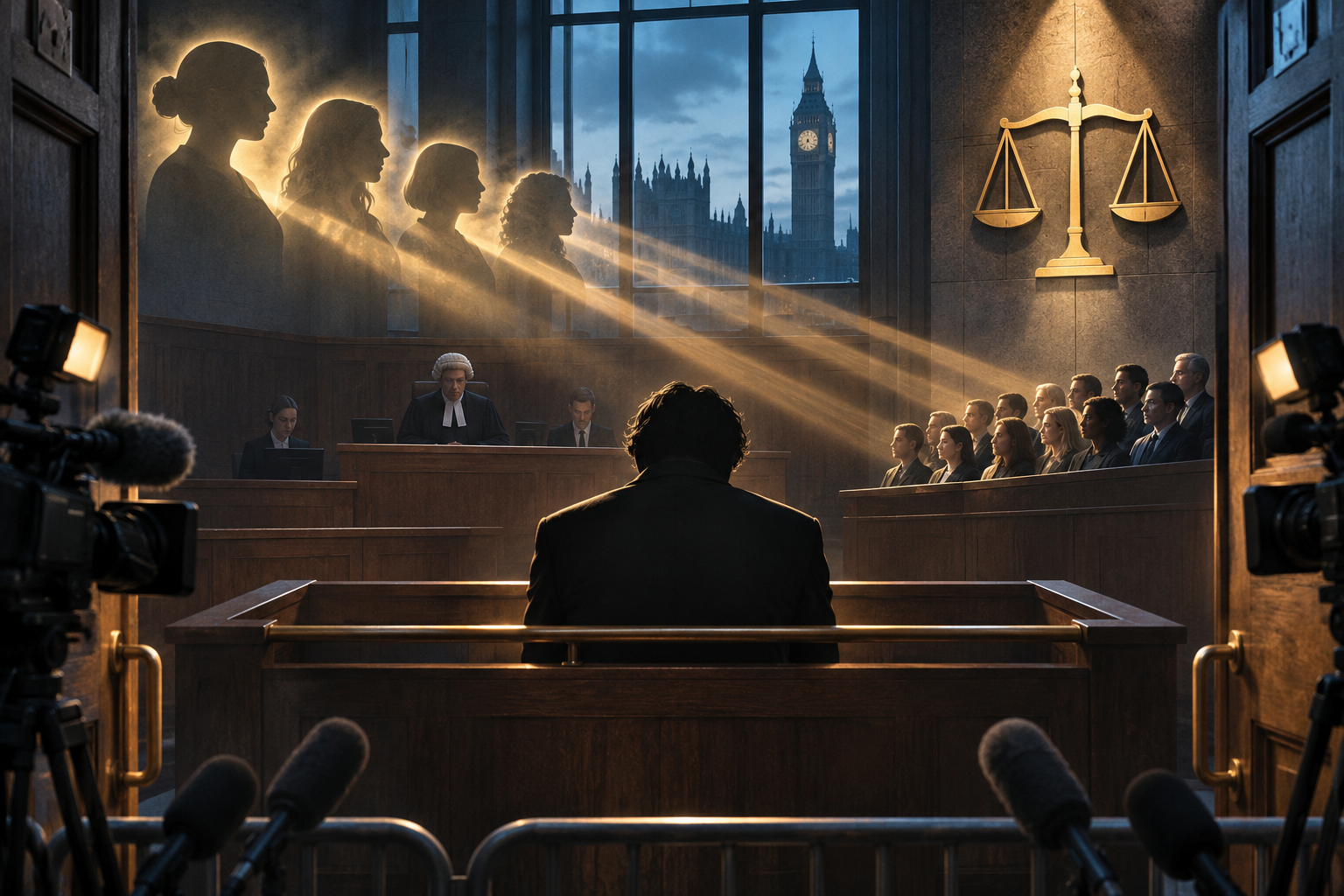
LONDON - British comedian and actor Russell Brand has been convicted of raping one woman and sexually assaulting three others, concluding a four-week trial that examined offences committed as his public profile grew across British television and film.
A jury at Southwark Crown Court found the 51-year-old guilty of one count of rape and three counts of sexual assault involving four women. The offences took place between 2004 and 2009, according to the Metropolitan Police and Crown Prosecution Service.
Brand was cleared of two other rape charges and one count of attempted indecent assault. He had denied all seven charges and told police and jurors that he had never engaged in non-consensual sexual activity.
The convictions concerned four separate incidents. Jurors found that Brand grabbed a woman's breasts at a London bar in 2004, assaulted another woman at a radio station in 2004 or 2005, raped a woman at his London home in 2009 and sexually assaulted a woman during the recording of an advertisement later that year.
The judge remanded Brand in custody after the verdict and told him he would receive a prison sentence. The court will determine the punishment at a separate sentencing hearing.
The four women did not know one another. They contacted police after a 2023 investigation by The Sunday Times, The Times and Channel 4 broadcast allegations from other women. Those reports prompted the Metropolitan Police to begin the investigation that led to the trial.
Brand rose from stand-up comedy to become one of Britain's most prominent broadcasters, working for the BBC and Channel 4 before appearing in Hollywood films. In recent years, he developed a large online audience through commentary on politics, religion, wellness and free speech.
The verdict has renewed scrutiny of how British broadcasters handled complaints and concerns about powerful performers. Channel 4 previously said a complaint connected to a 2009 incident had not been escalated to senior management at the time. A BBC review found that some staff felt unable to raise concerns about Brand's conduct during his years at the broadcaster.
Police said the investigation was continuing. Metropolitan Police Commissioner Mark Rowley urged other potential victims to speak with detectives and said officers were examining two further rape allegations. Those additional allegations have not been proved in court and Brand has not been convicted in relation to them.
Fame delayed accountability, but did not defeat it
The conviction establishes four crimes beyond a reasonable doubt. It does not validate every allegation ever made about Brand, and the acquittals on three charges must also be respected. That distinction is not a technicality; it is what separates justice from a public campaign driven by rumor.
At the same time, the case exposes how status can distort the environment around misconduct. When a performer's outrageous behavior is profitable, colleagues may learn that objecting carries professional risk while silence carries none. A personality marketed as unpredictable can receive freedoms that would never be granted to an ordinary employee.
That culture does not make every accusation true. It can make truthful accusations harder to report. Victims may fear disbelief, retaliation or the destruction of their careers, particularly when the accused person has access to executives, lawyers, producers and a devoted audience.
The women in this case came forward years after the offences. The passage of time is often used to question complainants, but delayed reporting is common when shame, fear and unequal power are involved. The proper answer is investigation and a fair trial, not automatic belief or automatic dismissal.
Brand's later political identity also complicated public reaction. He built a following that viewed institutions and mainstream media with suspicion, then presented the allegations as part of a broader attack on his voice. Powerful people across the ideological spectrum have used that defense: turn a personal accusation into a test of loyalty to a cause.
Free speech protects a person's right to criticize governments, broadcasters and cultural orthodoxies. It does not provide immunity from criminal law. Nor should political dislike substitute for evidence. The jury heard the testimony, assessed the defense and returned a mixed set of verdicts, convicting on four charges and acquitting on three.
That outcome demonstrates why courts matter. The process did not accept every claim, but it also did not treat fame as reasonable doubt. Democratic justice is strongest when it can reach a celebrity without abandoning the standards that protect every defendant.
Broadcasters now owe the public more than expressions of concern. They should show how complaints are recorded, escalated and investigated, and how junior staff can report misconduct without risking their livelihoods. Institutions that benefited from a star's behavior cannot claim surprise after years of warning signs.
The verdict cannot return the years lost by the women who testified. It can establish that delay is not the same as impunity. Other potential complainants should receive a serious investigation, while every new allegation remains an allegation unless proved. Accountability requires both courage and discipline.
Comments
Loading comments…