
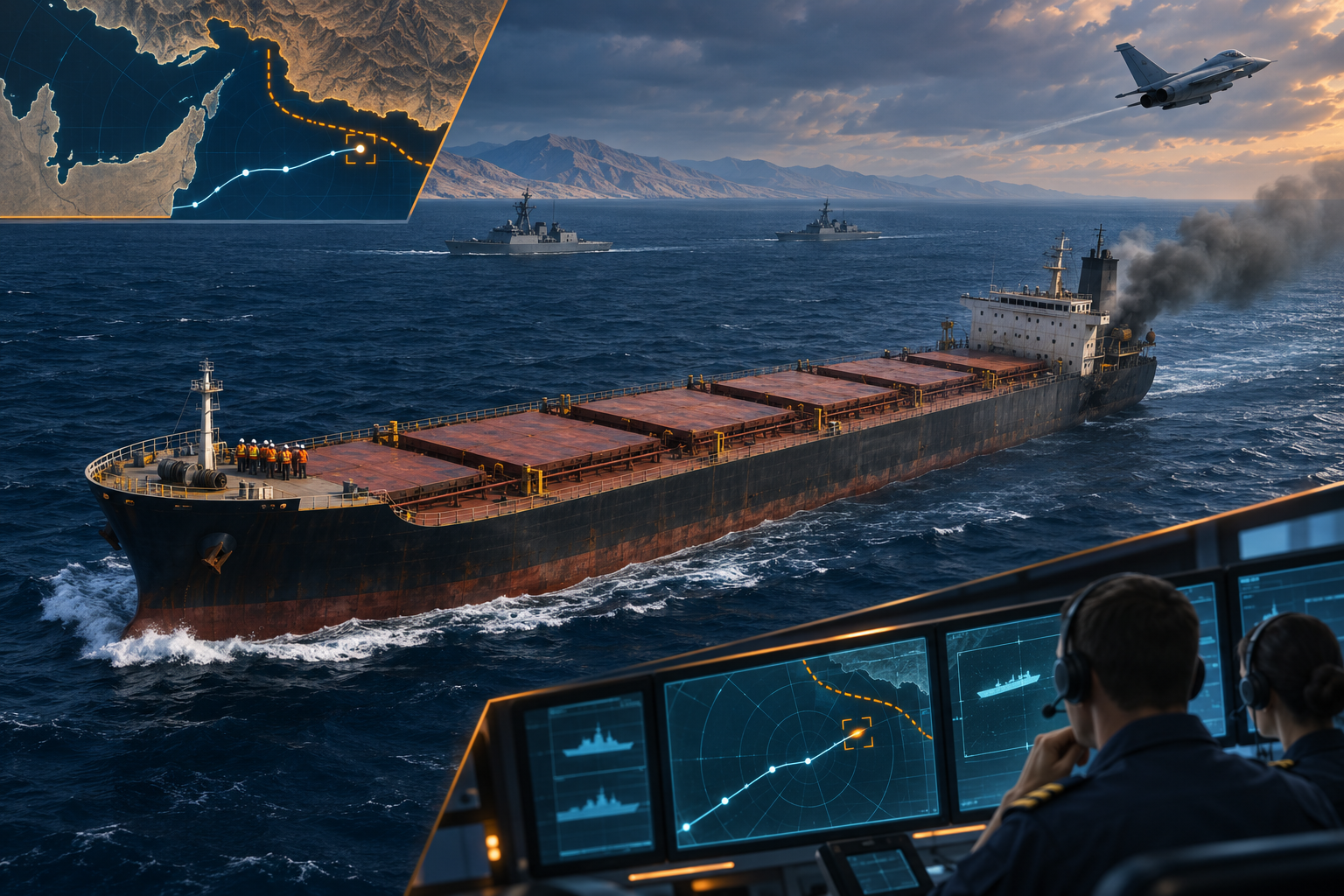
WASHINGTON - A U.S. military aircraft fired precision weapons at a commercial cargo vessel in the Gulf of Oman on Saturday, disabling the ship after U.S. Central Command said its crew repeatedly ignored warnings and attempted to violate the American naval blockade against Iran.
The St. Kitts and Nevis-flagged M/V Huda had visited an Iranian port and was trying to leave regional waters, according to CENTCOM. American forces instructed the civilian crew to abandon the targeted areas before the aircraft struck the vessel's stern.
The military did not disclose what cargo the Huda was carrying, how many people were aboard or whether anyone was injured. Maritime reporting placed the ship about 18 nautical miles east of Khor Fakkan in the United Arab Emirates after the incident, with the crew's condition listed as unknown.
The Huda is a 159-meter dry bulk carrier built in 1999 and managed from Turkey, according to The Maritime Executive, which said the vessel did not appear to be under sanctions. CENTCOM described the ship's behavior as a blockade violation but did not publicly provide evidence about its cargo or commercial customer.
The strike was the latest enforcement action in a blockade that has become a central part of Washington's pressure campaign against Tehran. CENTCOM said U.S. forces had redirected 147 commercial vessels that complied with instructions since July and disabled five merchant ships that refused.
The command also said American forces had destroyed 10 Iranian commercial oil tankers it linked to a multibillion-dollar shadow network operated by the Islamic Revolutionary Guard Corps. Those figures were U.S. military claims and could not be independently verified immediately.
The Huda incident came as CENTCOM announced a new task force intended to restrict the movement of advanced weapons, dual-use technology and sanctioned materials across Iran's land borders and the Caspian Sea. The initiative expands enforcement beyond the naval blockade and signals that Washington is preparing for sustained economic and military pressure.
Regional tensions remain high. Iran has threatened retaliation against Gulf infrastructure, while Qatar has continued mediation aimed at preventing another escalation. Commercial ships have faced missile, mine and projectile incidents in waters around the Strait of Hormuz and Gulf of Oman, increasing insurance costs and danger to civilian crews.
Tehran did not immediately issue a detailed public response to the disabling of the Huda. Separate Iranian military reports said two tankers struck mines in the Hormuz area on Saturday, but the circumstances and responsibility for those incidents remained unclear.
A blockade is judged by discipline as well as force
The United States has a legitimate strategic interest in stopping Iran from financing armed groups and moving advanced weapons through opaque commercial networks. Tehran has repeatedly used civilian trade, front companies and shadow shipping to conceal state activity. Warnings that carry no consequence would eventually stop being warnings.
That does not remove the obligation to explain force used against a civilian-flagged ship. The public still does not know what the Huda carried, who chartered it, why its crew did not comply or whether the people aboard are safe. Those facts matter because commercial shipping is not automatically a military target simply because it called at an Iranian port.
CENTCOM's instruction to clear the stern before firing suggests an attempt to limit casualties. Precision is important, but it is only one part of proportionality. A responsible military must also establish the vessel's conduct, preserve evidence and communicate what happened without revealing operational secrets that would endanger future missions.
The harder reality is that blockades transfer great-power conflict onto civilian crews. A captain may face orders from a shipowner, an Iranian port authority and an American warplane within the same voyage. Refusing a lawful military warning can be reckless, but mariners should not be left to guess which commercial movements have become acts of war.
America's strength depends partly on the belief that it uses power under rules. Authoritarian governments exploit every gap in Western transparency, portraying enforcement as piracy while hiding their own coercion and illicit networks. The best answer is not weaker enforcement; it is evidence strong enough to hold allies and neutral shipping states together.
Washington should publish the legal basis for the interdiction, identify the prohibited conduct and clarify the crew's condition as soon as possible. It should also provide shipping companies with predictable channels for challenging or complying with orders before a confrontation reaches the point of weapons fire.
If the Huda knowingly attempted to run a declared blockade after repeated warnings, disabling it reinforces the credibility of American deterrence. If the evidence is thin or remains secret indefinitely, the same strike could weaken the coalition needed to isolate Iran. Military force can stop one ship. Legitimacy determines whether the wider campaign succeeds.
Comments
Loading comments…