
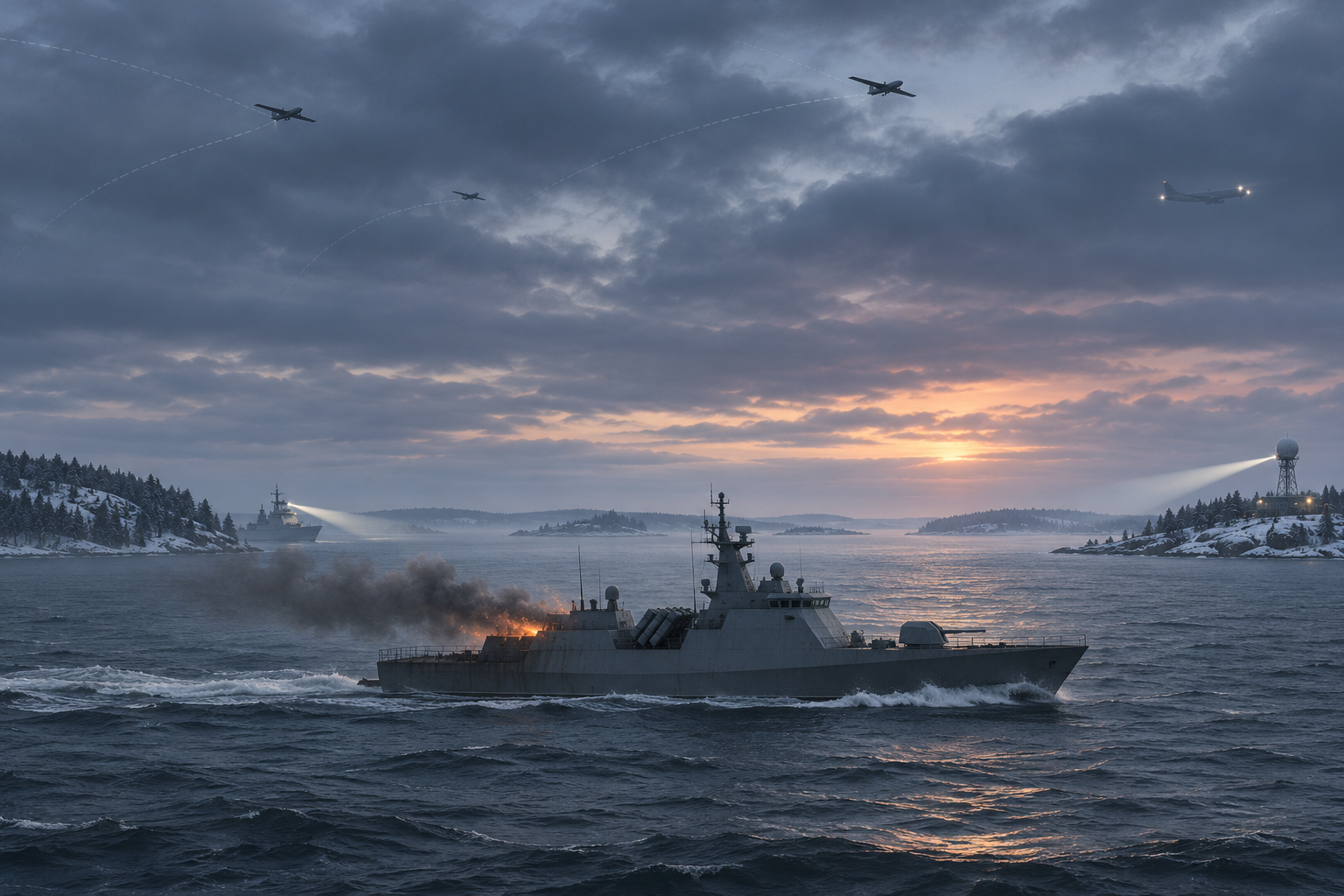
HELSINKI - Finland has confirmed that a Russian warship was struck in the Gulf of Finland, while Ukraine says it carried out the attack against a missile-armed vessel during a wider drone operation near St. Petersburg.
The Finnish Defence Forces said they detected a strike on a Russian naval vessel Wednesday and monitored the situation. Officials said the security environment remained stable and that Finland faced no immediate military threat.
Finland did not identify the weapon, exact location, damage or casualties. Russia had not publicly confirmed the incident by Thursday, leaving important parts of Ukraine's account unverified.
Ukraine's Security Service, known as the SBU, said it used drones against the Naro-Fominsk, a Buyan-M-class small missile ship. The agency said the operation was planned as part of a broader attack on port, oil-processing and transport infrastructure around Ust-Luga in Russia's Leningrad region.
A senior Finnish official told public broadcaster Yle that the attack was detected near the Russian island of Gogland, known in Finland as Suursaari. The island is about 40 kilometers from Finland and roughly 55 kilometers from Estonia.
Estonian Defence Minister Martin Herem told public broadcaster ERR that an explosion occurred aboard a Russian warship and that the vessel later headed toward St. Petersburg. That account supports the occurrence of an onboard blast but does not independently establish how the ship was hit.
Defense publication Janes reported that the SBU did not release evidence of the damage or specify the weapon used. It said the Buyan-M design can carry Kalibr cruise missiles and P-800 Oniks anti-ship missiles, systems Russia has used during its war against Ukraine.
The Finnish Defence Forces temporarily restricted parts of the eastern gulf's airspace and maritime area during the broader drone activity. Estonia, Latvia and Lithuania issued shelter warnings early Wednesday, and NATO aircraft were scrambled as drones moved toward Russia's northwest.
The Gulf of Finland is a narrow and heavily monitored arm of the Baltic Sea between Finland and Estonia, ending at St. Petersburg. Civilian ferries, cargo traffic, energy infrastructure and military activity operate within a confined space, making any strike there especially sensitive.
Ukraine has repeatedly attacked Russian oil and military targets far from its border as Moscow continues long-range strikes against Ukrainian cities and infrastructure. A successful hit in the open Baltic would demonstrate a new reach, but available evidence does not yet establish the extent of the damage.
A battlefield is moving closer to NATO territory
A Russian military ship capable of launching cruise missiles is a legitimate strategic target for a country defending itself from invasion. Ukraine has strong reason to disrupt platforms and logistics that enable attacks on its population.
The location still changes the risk. A drone operation close to Finnish and Estonian territory can trigger air-defense alerts, close civilian routes or produce debris inside a NATO member's jurisdiction. Even a technically successful strike can create a dangerous misunderstanding when governments have only minutes to decide what crossed their border.
Russia bears the fundamental responsibility for expanding this war. It invaded Ukraine and has used missiles, sabotage, covert influence and pressure on European infrastructure. Moscow cannot reasonably claim that its military assets should remain untouched simply because it moved them farther from the original front.
At the same time, Ukraine and its supporters need credible notification procedures with Baltic allies. Operational secrecy is necessary, but neighboring democracies must be able to distinguish a Ukrainian mission from a Russian attack or an uncontrolled aircraft before they respond.
Finland's measured statement was useful. It confirmed what its sensors detected, avoided repeating unverified casualty claims and told the public there was no immediate threat. That is how governments should communicate during a fast-moving military incident.
The strike also exposes a weakness in Russia's assumption that distance provides sanctuary. Ports and missile ships near St. Petersburg are no longer automatically beyond Ukraine's reach. Defending them will force Moscow to disperse air defenses and surveillance assets that could otherwise be used against Ukraine.
The harder reality is that the Baltic is becoming an extension of the war even when NATO forces are not participants. Drones, naval patrols, shadow-fleet tankers and vulnerable undersea cables share the same narrow waters. Preventing a larger conflict now depends on helping Ukraine defend itself while ensuring that one uncertain radar track does not become the spark for direct NATO-Russia confrontation.
Comments
Loading comments…