
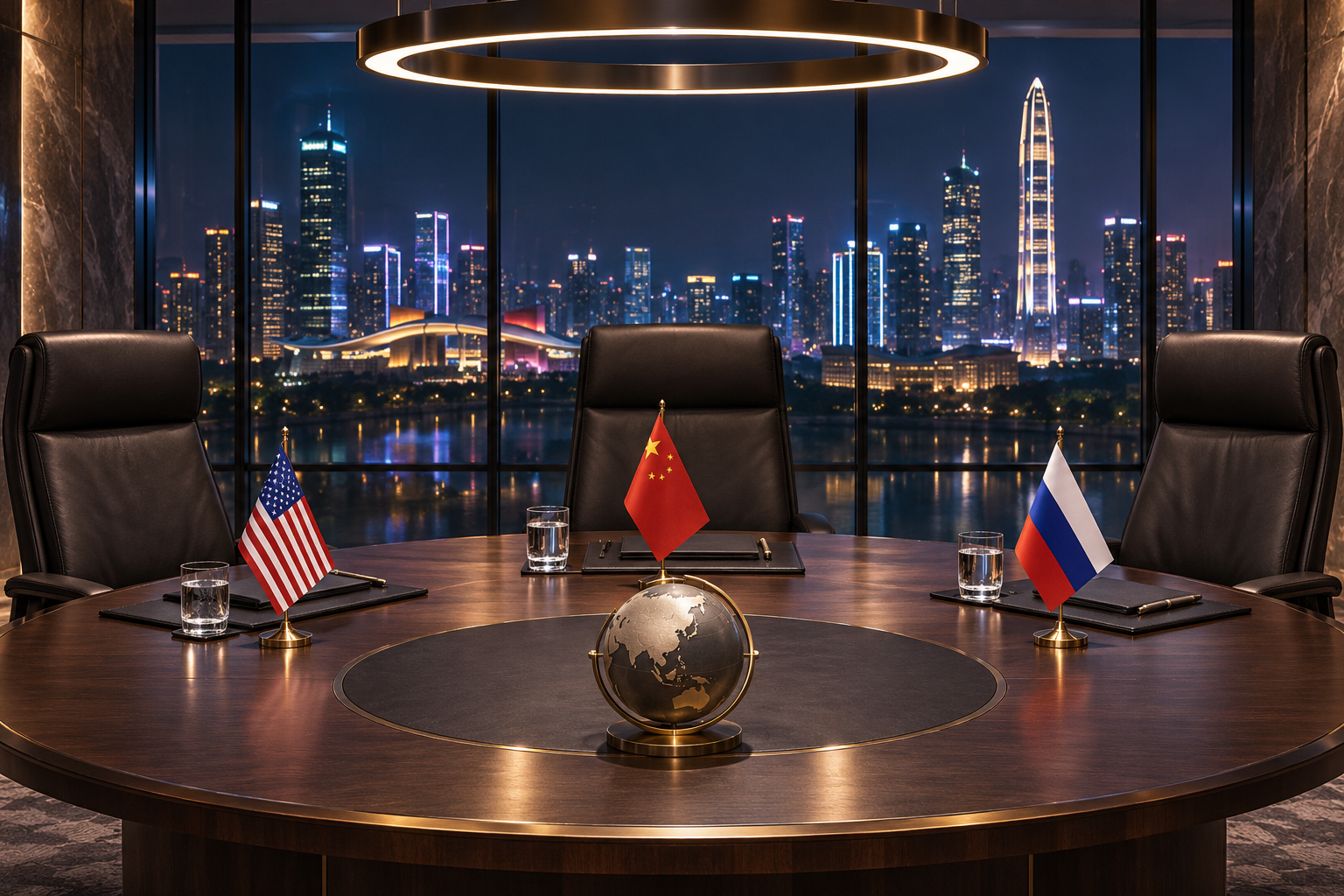
WASHINGTON - President Donald Trump, Chinese President Xi Jinping and Russian President Vladimir Putin plan to hold an unprecedented three-way meeting in Shenzhen next Thursday on the sidelines of the Asia-Pacific Economic Cooperation summit, the White House confirmed Friday.
The gathering will place the leaders of the world's three largest nuclear powers at the same table. A senior U.S. official said the Trump administration views it as the beginning of a possible arms-control conversation rather than a negotiation expected to produce an immediate agreement.
Trump plans to raise the U.S. war with Iran and his goal of a new nuclear framework that includes China, according to the official, who briefed reporters on condition of anonymity. The president is not expected to make Russia's war against Ukraine a central subject of the trilateral discussion.
The APEC Economic Leaders' Meeting is scheduled for November 18 and 19. China's Foreign Ministry said Xi will chair the gathering in Shenzhen, host a welcome banquet and hold meetings with visiting leaders. APEC brings together 21 Asia-Pacific economies.
The nuclear discussion comes after New START, the last treaty limiting the strategic arsenals of the United States and Russia, expired in February. Trump rejected Moscow's proposal for a one-year extension and called for a broader agreement that would include Beijing.
The difference in arsenal size makes that difficult. Pentagon estimates cited by the Associated Press put China's stockpile at more than 600 warheads, while the United States and Russia each possess more than 5,000. Beijing has historically argued that Washington and Moscow should reduce their much larger inventories before asking China to accept comparable limits.
The U.S. official said no agreement is expected to be announced in Shenzhen. The purpose is to test whether the three governments can begin a sustained conversation at a time when formal restraints have weakened and military competition is increasing.
The meeting also carries risks beyond arms control. Putin is seeking international legitimacy while continuing Russia's nearly five-year war against Ukraine. China has increased its economic and technological support for Moscow, while maintaining that it is neutral and blaming Western policy for contributing to the conflict.
Ukrainian President Volodymyr Zelenskyy has warned that the gathering must not become a venue for deciding Ukraine's future without Kyiv. European leaders have also expressed concern about major-power diplomacy that excludes the countries most directly affected.
Xi and Putin have met more than 40 times since Xi took power in 2013. Trump has met Putin seven times and Xi eight times, according to the Associated Press. What is new is the decision to place all three leaders together in a formal session.
Dialogue is necessary, but the stage favors Beijing and Moscow
A direct conversation among three nuclear powers is better than silence. With New START gone and no replacement ready, even a basic agreement to continue technical talks could reduce the risk of miscalculation and create a path toward transparency.
But symbolism is not neutral. Beijing can present the meeting as evidence that China now stands beside the United States as an equal architect of global order. Moscow can use the same image to argue that its invasion of Ukraine has not isolated Putin. Both leaders gain prestige before making a single concession.
Trump therefore needs to define success in American terms. A serious process should include verifiable warhead and delivery-system data, military communication channels and limits that can be inspected. Vague promises of friendship would give authoritarian governments the photograph while leaving the United States with no enforceable protection.
Ukraine and Taiwan must not become bargaining chips. The people facing Russian invasion and Chinese coercion are not obstacles to great-power stability; their security is part of it. Any private discussion that appears to trade their sovereignty for cooperation elsewhere would weaken American alliances and reward military pressure.
China's reluctance to join arms control is understandable in numerical terms but incomplete in strategic terms. Beijing is rapidly expanding its arsenal and operates with far less transparency than Washington. A smaller stockpile does not remove the need for notification, crisis communication and verifiable limits as it grows.
The United States should enter the room confident in its alliances, economic strength and democratic legitimacy. It should also publish a clear account afterward of what was discussed and what was not agreed. Transparency will make it harder for Beijing or Moscow to describe the meeting as approval of their territorial ambitions.
The hard reality is that diplomacy with authoritarian powers is necessary precisely because trust is limited. A useful summit will not be measured by ceremony in Shenzhen. It will be measured by whether the three governments accept rules that can be checked after the flags and cameras are gone.
Comments
Loading comments…